
Minimum spend for nightclub tables: how to set it
A minimum spend is what a party agrees to spend at a table in return for having it for the night. Set it from what the table can earn, tell the guest before they book, and it stops being an argument at two in the morning.
Key takeaways
- A minimum spend is a promise to spend, not a fee: the guest gets drinks to that value.
- Start from what the table sells on most good nights, then adjust for its position and the night.
- Say what counts towards the minimum, and what does not, before the guest books.
- Review the minimums after every big night: a table that always sells first is priced too low.
A VIP table is the most valuable floor space in a club. A group that takes one for the night and orders two rounds of soft drinks costs you the party that would have ordered bottles. The minimum spend is how you make sure a table earns its place, and how the guest knows what the night will cost before they arrive.
What a minimum spend is
A minimum spend, also called a table minimum, is the amount a party commits to spending on drinks at their table. It is not a booking fee and not a cover charge: the guest gets bottles, mixers and anything else on the menu up to that value. If the bill ends below the minimum, they pay the difference, usually by adding a bottle that takes the total over the line.
Three terms get mixed up, so it helps to pin them down:
- Minimum spend
- What the party agrees to spend at the table over the night.
- Bottle minimum
- The same idea counted in bottles instead of money: a booth for eight comes with at least two bottles.
- Deposit
- Money taken in advance to hold the table, normally counted towards the minimum. Some clubs take one through their payment provider; many do not.
How to set the number
Do not start from what the club down the road charges. Start from your own tills.
- Take the last eight to ten comparable nights and work out what each table sold. If your tills cannot split sales by table, count the bottles sent to each one.
- Find the amount the table reached on most of those nights. Leave out the one huge birthday: a minimum built on the best night ever keeps the table empty on the others.
- Divide by the seats. The result should be a figure each guest at that table would spend on a night out anyway.
- Adjust for the table, the night and the party, as below.
Minimum spend = what the table sells on most good nights, adjusted for position and night
Check: minimum ÷ seats = a figure each guest would spend anyway
Three things move the number:
- Position
- Tables by the DJ booth and the dance floor go first and can carry the highest minimum. Tables at the back or beside the bar carry less.
- The night
- A regular Friday, a headline DJ and New Year's Eve are three different price lists. Set them as fixed tiers instead of improvising each time.
- Party size
- The minimum belongs to the table, not to the number of people. A booth for eight costs the same for a party of four, because they are taking eight seats.
A worked example
A club has eight booths, each seating eight. Looking back over ten Saturdays, a booth by the dance floor took between €450 and €1,100 and reached €600 or more on eight of them. The booths beside the bar reached €350 or more on eight of the ten. These figures are an illustration, not a benchmark.
| Step | Amount |
|---|---|
| Dance floor booth, reached on most nights | €600 |
| Per seat: 600 ÷ 8 | €75 |
| Minimum, regular Saturday | €600 |
| Bar-side booth, reached on most nights | €350 |
| Per seat: 350 ÷ 8 | €44 |
| Minimum, regular Saturday | €350 |
| Dance floor booth on a headline night, half as much again | €900 |
In this club €75 a head is about what a guest spends on a night out in any case, so the minimum asks nobody for more than they planned. On a headline night the dance floor booths go up by half, because those are the nights they sell out a week ahead. The bar-side booths stay where they are, so there is still a table for the party that wants one without the top price.
What counts towards it
Decide this once and write it down, because it is where most disputes start.
- Bottles, mixers and packages ordered at the table count. Say whether drinks fetched from the bar count too. In most clubs they do not, because nobody can tie them to the table.
- Say whether the figure includes VAT and service. Guests assume the number they were told is the number on the bill.
- Say whether the table includes entry, and for how many people.
- A minimum normally buys the table for the night. If you turn tables, say when the booking ends.
- Say what happens when the bill is under the minimum. The usual answer is that the party chooses a bottle to make up the difference.
Agree it before the night
A minimum that the guest hears for the first time from a waiter at the table feels like a trap. One they saw when they chose the table is simply the price. Show it at the moment of booking, next to the table it belongs to, and repeat it in the confirmation.
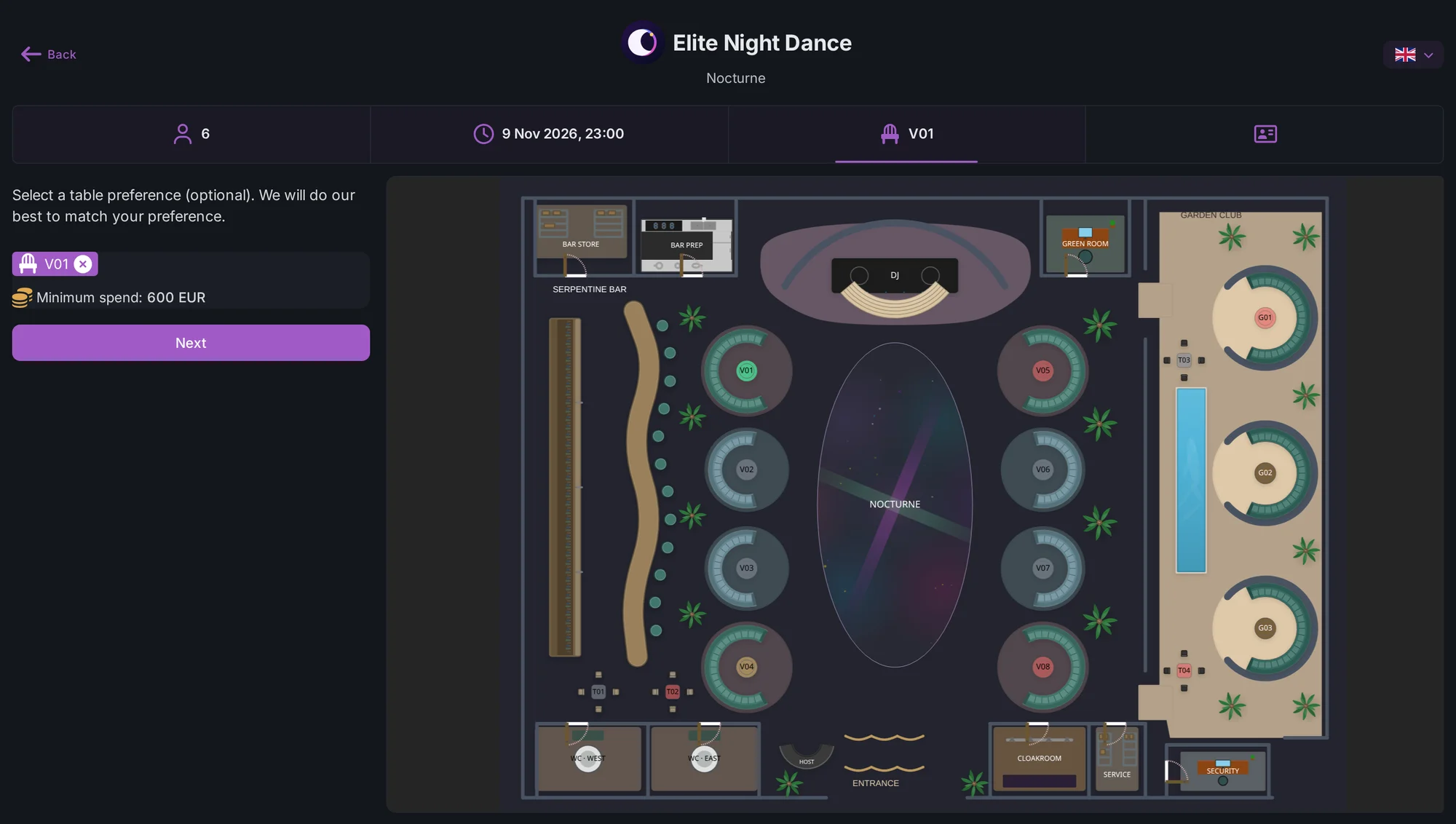
The same goes for your own team. The door, the hosts and the promoters should all quote the same figure for the same table on the same night. If a promoter can promise a booth for less, the real minimum is whatever the cheapest promise was.
When a party is too big for one table, add up the minimums of the tables they take. A group of twelve across two booths is using two booths' worth of your floor.
Common mistakes
- One minimum for every table. The best tables sell out first and the rest stay empty.
- Copying another club's numbers. Their room, prices and crowd are not yours.
- Waiving it for friends. Every waived minimum is noticed by the party at the next table.
- Setting it so high that booths stand empty. An empty booth earns nothing and makes the room look quiet.
- Never changing it. If the dance floor booths are gone ten days ahead every week, they are priced too low. If they are still free at midnight, they are priced too high.
Look at the minimums again after every big night, with the list of what each table sold in front of you. Move one tier at a time and give it three or four weekends before you judge it.
Minimum spend in Firetable
In Firetable you set a minimum spend on each table when you draw the floor plan, next to its capacity, as an amount or as a number of bottles. Guests see it in the booking widget as soon as they pick that table, so it is agreed before the request is sent. Every night is an event with its own floor plan, so a headline night can run on a plan with higher minimums than a regular Saturday. On the night, guests open your bottle menu from the QR code on their table and order from their seat, with packages and the saving shown. See bottle service software for the menu and the orders, and nightclub reservation software for the booking side.