
Bottle service menu: how to build and price it
Every bottle on the menu has to earn its margin, and the list as a whole has to let a table reach its minimum without doing sums. Price it from what the bottle costs you and from what your tables spend, and keep it short enough to read in the dark.
Key takeaways
- Price each bottle from two sides: what it costs you as served, and what a table in your room spends.
- Build the list in even steps, so every table minimum can be reached with one or two obvious choices.
- A package needs a real saving against the same bottles bought singly, and should be the easy answer for a big table.
- Mark what is sold out and change prices before doors open, not at the table.
At a table, nobody compares your bottle price with the shop. They compare it with the table next to them, with the minimum they agreed to, and with what the night is worth to them. That gives you room, but only if the menu is built on purpose. A list copied from the bar menu with a zero added sells the cheapest vodka all night.
What the menu has to do
A bottle menu does three things at once:
- It makes a margin on every bottle, after the mixers, the ice and the service that go with it.
- It lets a table reach its minimum spend without arithmetic.
- It gives the guest a reason to move one step up.
Keep those three in mind and most pricing questions answer themselves.
How to price a bottle
Work from two sides and let them meet.
From what it costs you
Start with what the bottle costs you without VAT, and add what goes to the table with it: mixers, ice, garnish, the sparkler if you use one. That is the cost of the bottle as served. Divide it by the menu price without VAT and you have its pour cost, the share of the price that the goods take.
Cost as served = bottle cost + mixers, ice and garnish
Pour cost = cost as served ÷ menu price without VAT × 100
A bottle at a table normally carries a much lower pour cost than the same spirit sold by the measure, because the price also pays for the table, the host and the night. The pour cost calculator does the sum for you: set the pour to the full bottle.
From what a table spends
Then look at what your tables spend. If a booth for eight has a minimum of €600, the menu should let that party get there with two or three bottles they would choose anyway. A list where the cheapest bottle is €90 turns a €600 minimum into seven bottles of the same vodka. A list where the standard bottles sit around €190 turns it into three, and leaves room for a fourth.
The right price is the one where both sides agree: the margin is there, and the table reaches its minimum comfortably.
A worked example
A club buys a 700 ml bottle of premium vodka for €24.00 without VAT. Each bottle goes out with six cans of mixer at €0.50 each, and ice and garnish worth about €1.00. The club wants the bottle on the menu at €190, including 20 per cent VAT. These figures are an illustration, not a benchmark.
| Step | Amount |
|---|---|
| Bottle cost | €24.00 |
| Mixers: 6 × 0.50 | €3.00 |
| Ice and garnish | €1.00 |
| Cost as served | €28.00 |
| Menu price without VAT: 190 ÷ 1.20 | €158.33 |
| Pour cost: 28.00 ÷ 158.33 | 17.7% |
| Margin per bottle | €130.33 |
On a booth with a €600 minimum, three of these bottles come to €570 and a fourth takes the table well past it. That is a menu doing its job: the minimum is all but reached by the third bottle, and the fourth is an easy yes.
Build the list in steps
Guests read a bottle menu from the top and stop early. Order it so that stopping early is fine for you.
- Three price levels per spirit are enough: a standard bottle, a premium one and one for the table that wants to be seen.
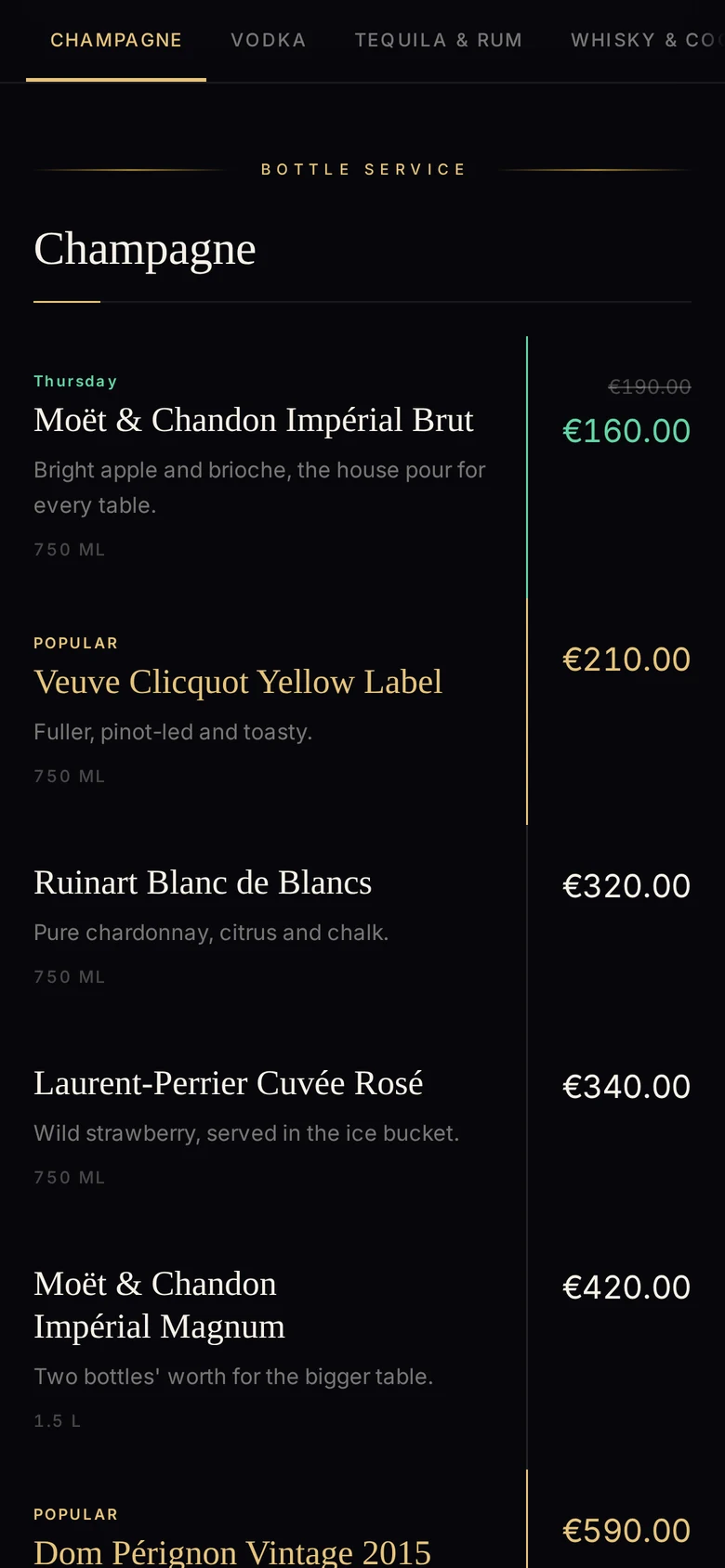
- Keep the steps even. If vodka goes €160, €190, €320, most tables stop at €190. If it goes €160, €210, €260, more of them take the middle.
- Put large formats where they help. A magnum priced a little under two single bottles is the natural order for a big table.
- Match the list to your minimums. For each table minimum, check that there is an obvious combination that reaches it.
- Keep it short. A guest in a dark room with music will not read thirty lines.
Packages and the saving
A package is a fixed set of bottles for a party, sold at one price. It works when it is the easy answer for a big table: one decision instead of four.
- Show the saving against the same bottles bought singly, and make it real. A package that saves 2 per cent is a list, not an offer.
- Build it around a table. A package for ten should hold what ten people drink in a night, with the mixers to match.
- Price it at or just above the minimum of the table it is meant for, so taking the package settles the minimum in one order.
- Do not discount your best seller inside it. Put the saving on the bottle you would like to sell more of.
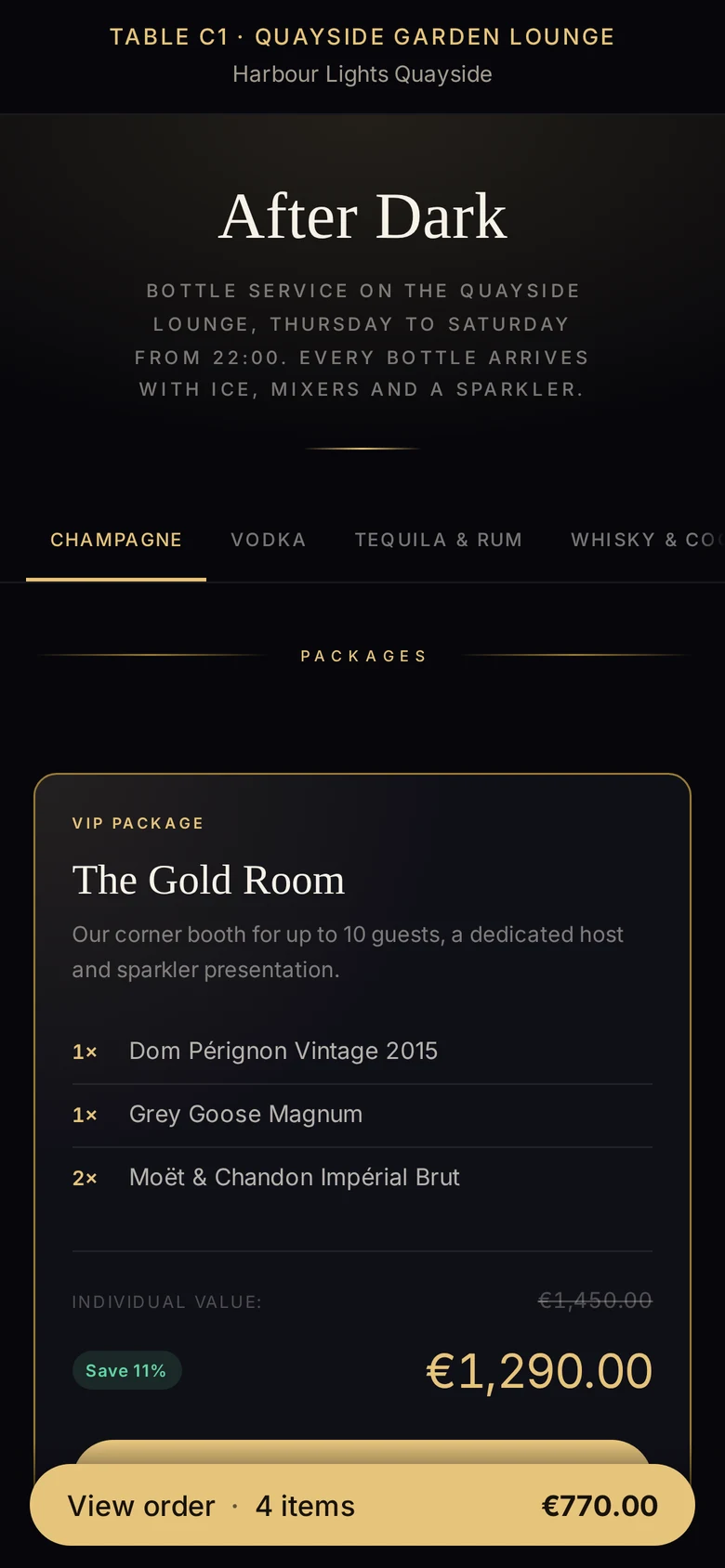
For example, a package of one prestige champagne, one magnum of vodka and two bottles of house champagne might come to €1,450 bought singly. Offered at €1,290, it saves the table 11 per cent and still sells four bottles in one order.
Mixers, specials and sold-out bottles
- Mixers
- Decide what comes with a bottle and say it on the menu. If mixers are included, their cost belongs in the bottle price. If they are extra, list them with prices, so nobody is surprised by the bill.
- Specials
- A lower price on one bottle on a quiet night can move a table up from the house pour. Tie it to a night, show the usual price beside it and take it off when the night is over.
- Sold-out bottles
- Mark a bottle as sold out the moment the last one leaves the store room. A guest who orders it and is told no will usually trade down, not up.
- Prices on the night
- Change prices before doors open, never during the night. A table that sees two prices for the same bottle will argue about both.
Common mistakes
- Pricing bottles by multiplying the bar price, without looking at what tables spend.
- Too many bottles, so guests pick the cheapest because it is the only one they can find.
- Packages with no visible saving, or with a saving so large that nobody buys single bottles any more.
- A menu that does not line up with the minimums, so a table cannot reach its minimum without an awkward extra bottle.
- Forgetting VAT when working out the margin.
- Printed menus that are out of date by the second weekend.
Bottle menus in Firetable
In Firetable you build the bottle menu once and publish it as a page. Every table on your floor plan gets its own QR code, and the page a guest opens already knows which table it is. The menu shows packages with their saving, specials and bottles marked as sold out, and it can be published in several languages. Guests add bottles and mixers, leave a note and send the order, and your team confirms it. Change a price or mark a bottle sold out before doors open and every table's menu is current. Each table's minimum spend is set in the floor plan and shown to guests when they book. Firetable does not add up the bill against that minimum or take payment; your till does that. See bottle service software for the menu and the orders, and minimum spend for nightclub tables for setting the minimums.