
How to do a bar stock take, step by step
A stock take tells you what is really on the shelf, how far that is from what should be there, and why. This is a workflow for bars, nightclubs and beach clubs that keeps the count quick for the team and easy to review afterwards.
Key takeaways
- Decide what you are counting, and how, before anyone touches a bottle.
- Count blind, so the team records what is on the shelf rather than what the system expects.
- Review variances in order of cost, and rule out missing deliveries, unrecorded waste and unit mix-ups before you adjust.
- Count the expensive and fast-moving bottles more often than the rest.
Counting bottles is the easy part. Most of the value of a stock take comes from how you prepare it and what you do with the differences afterwards. Get those two right and a full count of a busy bar takes an hour or two, and the result is a number you can act on.
Why stock takes go wrong
Most counts fail before the first bottle is touched. The team starts late, nobody agreed whether the cellar and the terrace bar are in or out, and open bottles are counted three different ways. The count takes twice as long as it should, and the result is a number nobody trusts.
The second problem comes after the count. Four bottles of vodka short can mean four drinks poured without being rung through, a delivery that never made it into the system, or a case counted as a single bottle. When the review happens in a spreadsheet and a group chat, those causes blur together, and the same loss turns up again next month.
Before you count
Choose the kind of count
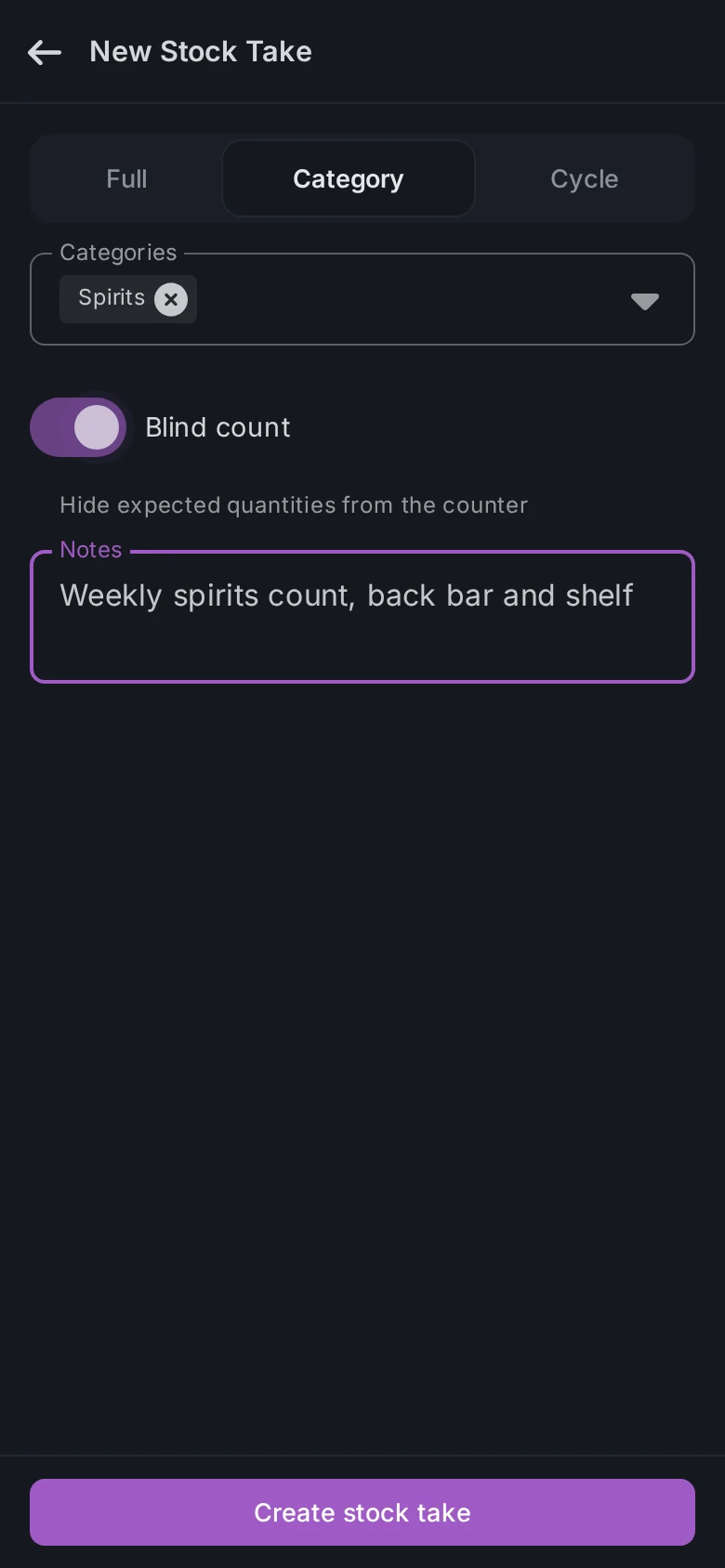
Not every count has to cover the whole venue. Three kinds cover most bars:
- Full count
- Every item in the venue. Do it at the end of each month or accounting period, and before the season changes.
- Category count
- One category, such as spirits or wine. A weekly spirits count catches problems with your most expensive stock early.
- Cycle count
- A handful of items you choose, counted often. Use it for the bottles that make most of your money, or go missing most.
Pick a moment when nothing moves
Count when no service is running and no delivery is due: after close, or before the first delivery of the day. Enter every delivery and every bit of recorded waste before you start, so the numbers you compare against are complete.
Agree how to count open bottles
Decide once how the team counts open bottles: in tenths, by weight, or not at all for cheap, fast-moving items. Write the rule down and use it every time. A change of method between two counts shows up as a variance that does not exist.
Walk the shelves in a fixed order
Set up the count in the order the stock sits: back bar left to right, then the fridges, then the store room. People who follow the shelf instead of an alphabetical list miss fewer items and finish sooner.
Counting, step by step
- Give each area to one person. Two people on the same shelf either count it twice or each assume the other one did.
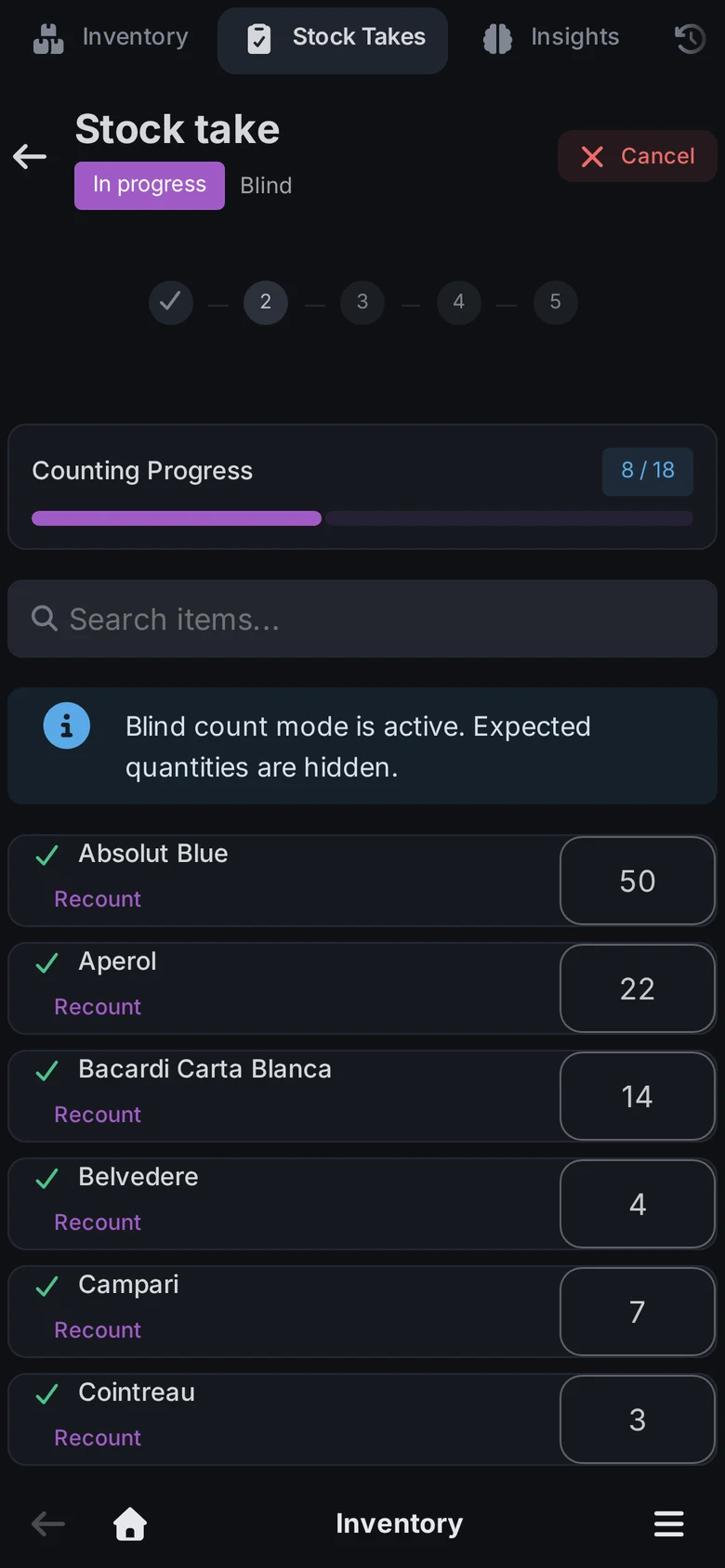
- Count blind. The person counting should not see how many bottles are expected. When the expected number is on screen, people tend to find it.
- Count full bottles first, then open bottles the way you agreed.
- Recount anything that looks wrong straight away, not the next day. Once the bar has served from that shelf, it is no longer the same shelf.
- Note anything unusual: a broken bottle in the bin, a case still in the car, stock set aside for a private event.
Review the variances before you adjust
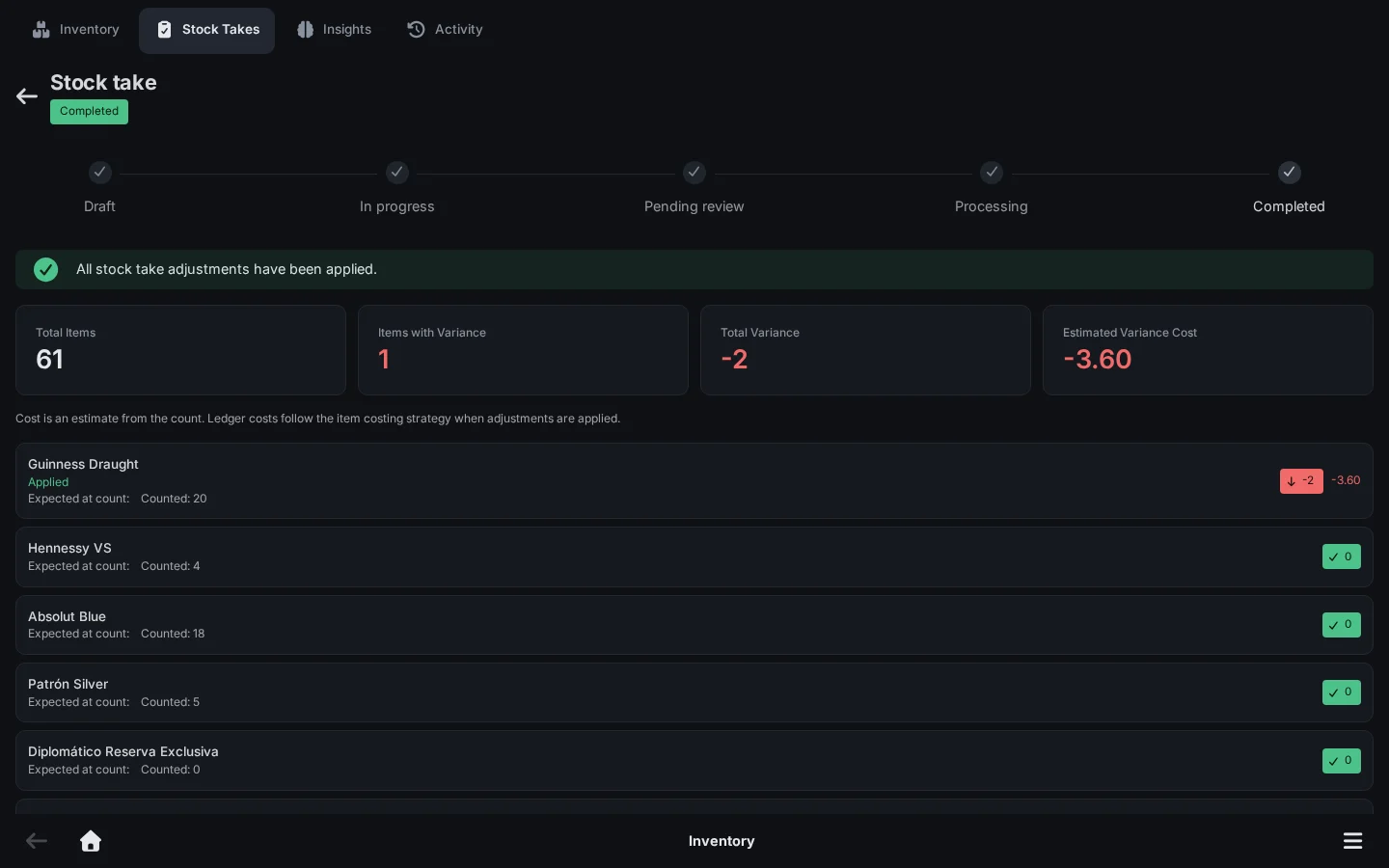
When the count is in, compare it with what you should have. The difference for each item is its variance. Work through them in order of cost, not of units: two missing bottles of an aged rum matter more than ten missing limes.
For every large variance, rule out the usual causes before you call it a loss:
- A delivery that arrived but was never entered, or was entered twice.
- Waste that happened but was not recorded: breakage, spillage, a bottle of wine that turned.
- A unit mix-up, such as a case of 24 counted as one, or a litre bottle entered as 70 cl.
- Stock set aside for an event or a private booking and counted somewhere else.
- A plain miscount. If in doubt, count the shelf again.
Then post the adjustments, each with a reason. What is left after the review is your real loss, and that is the number worth acting on. Our guide to reducing liquor waste goes through the fixes.
How often to count
A rhythm that works for most bars and clubs:
- A full count once a month, or at the end of each accounting period.
- Spirits and wine counted by category once a week.
- A cycle count of your best sellers and most expensive bottles two or three times a week in busy periods.
- An extra count after a big event or a festival weekend, while everyone still remembers what happened.
Counting more often makes each count smaller, and a variance found after three days is far easier to explain than one found after a month. The same counts show you how fast each item really sells, which is what you need to set par levels for your bar.
Stock takes in Firetable
In Firetable you start a full, category or cycle count from the inventory and switch on blind count, so the person counting never sees the expected quantities. The team counts on their phones. When the count is finished you review every variance with its estimated cost, and the adjustments are applied when you complete the review. Each adjustment is valued by the item's costing method: FIFO, FEFO or weighted average, explained in FIFO vs FEFO for bar inventory.