
Restaurant table turnover: how to measure and raise it
Table turnover is the number of parties a table seats in one service. It is the difference between a full dining room and a profitable one, and most of it is decided by how you take bookings, not by how fast guests eat.
Key takeaways
- Table turnover is parties seated divided by tables available, counted per service.
- Most lost turns come from gaps between bookings, not from slow guests.
- Give each party size its own booking length and offer times that fit two seatings.
- A waitlist and a quick reset turn an early departure into another party.
A restaurant sells time at a table. A table that seats one party in an evening and a table that seats two take the same rent, the same staff and the same kitchen. The second one earns nearly twice as much. That is table turnover, and it is worth measuring before you try to change it.
What table turnover is
Table turnover, also called the turn rate, is how many parties a table seats in one service. A turnover of 1 means every table was used once. A turnover of 2 means every table was used twice, or some three times and some once.
Two related numbers are worth knowing:
- Covers per seat
- Guests served divided by seats. It shows how well the seats are filled, including when a party of two sits at a table for four.
- Time at table
- How long a party stays, from sitting down to leaving. Together with the gap between two parties, it sets how many turns a service can hold.
How to measure it
Table turnover = parties seated in the service ÷ tables available
Turns a service can hold = length of the service ÷ (time at table + reset time)
Measure per service, not per day: lunch and dinner behave differently, and Friday is not Tuesday. Count parties, not guests. Count only the tables you could have used, so a table held back for a private party is not available.
Take four weeks of the same service and work out the average. That is your baseline. One good Saturday tells you nothing.
A worked example
A restaurant has 20 tables and serves dinner from 18:00 to 23:00. On an average Friday it seats 31 parties. Guests stay about 105 minutes, and it takes about 15 minutes from one party leaving to the next sitting down. These figures are an illustration, not a benchmark.
| Step | Result |
|---|---|
| Parties seated | 31 |
| Tables available | 20 |
| Table turnover: 31 ÷ 20 | 1.55 |
| Length of the service | 300 min |
| Time at table plus reset: 105 + 15 | 120 min |
| Turns the service can hold: 300 ÷ 120 | 2.5 |
The room can hold two full turns and part of a third, and it is getting 1.55. The gap is not slow eating. It is tables booked for 19:30 that stood empty from 18:00, and tables that emptied at 21:15 with nobody to take them. Getting from 1.55 to 1.8 on those 20 tables is five more parties every Friday.
What slows a table down
- Bookings in the middle of the service. A table booked for 19:30 can rarely be used before or after.
- Late arrivals, which push the rest of the evening back.
- No-shows and late cancellations, which leave a table empty at the time everyone wanted it. See how to reduce no-shows.
- Small parties at large tables.
- Slow resets: a table that stands uncleared for ten minutes while guests wait at the door.
- The bill. The time between a guest wanting to pay and being able to leave is the easiest to shorten, and the one guests thank you for.
- Nobody waiting. A table that frees up early is only worth something if there is a party to seat.
Booking lengths and seatings
The biggest change is in how you offer times. Decide how long each party size gets, and tell the guest when they book.
- A length for each party size
- Two people need less time than six. Give each size its own length, taken from how long your guests really stay, with a little margin.
- Two seatings
- Offer times that make two turns fit: an early seating and a late one. Keep the awkward middle times for tables that have already lost one turn.
- Late bookings
- A booking that starts late should end with the service, and the guest should know that when they book.
- Say it on the confirmation
- Tell guests how long the table is theirs. They accept a limit they were told about, and resent one they hear at the table.
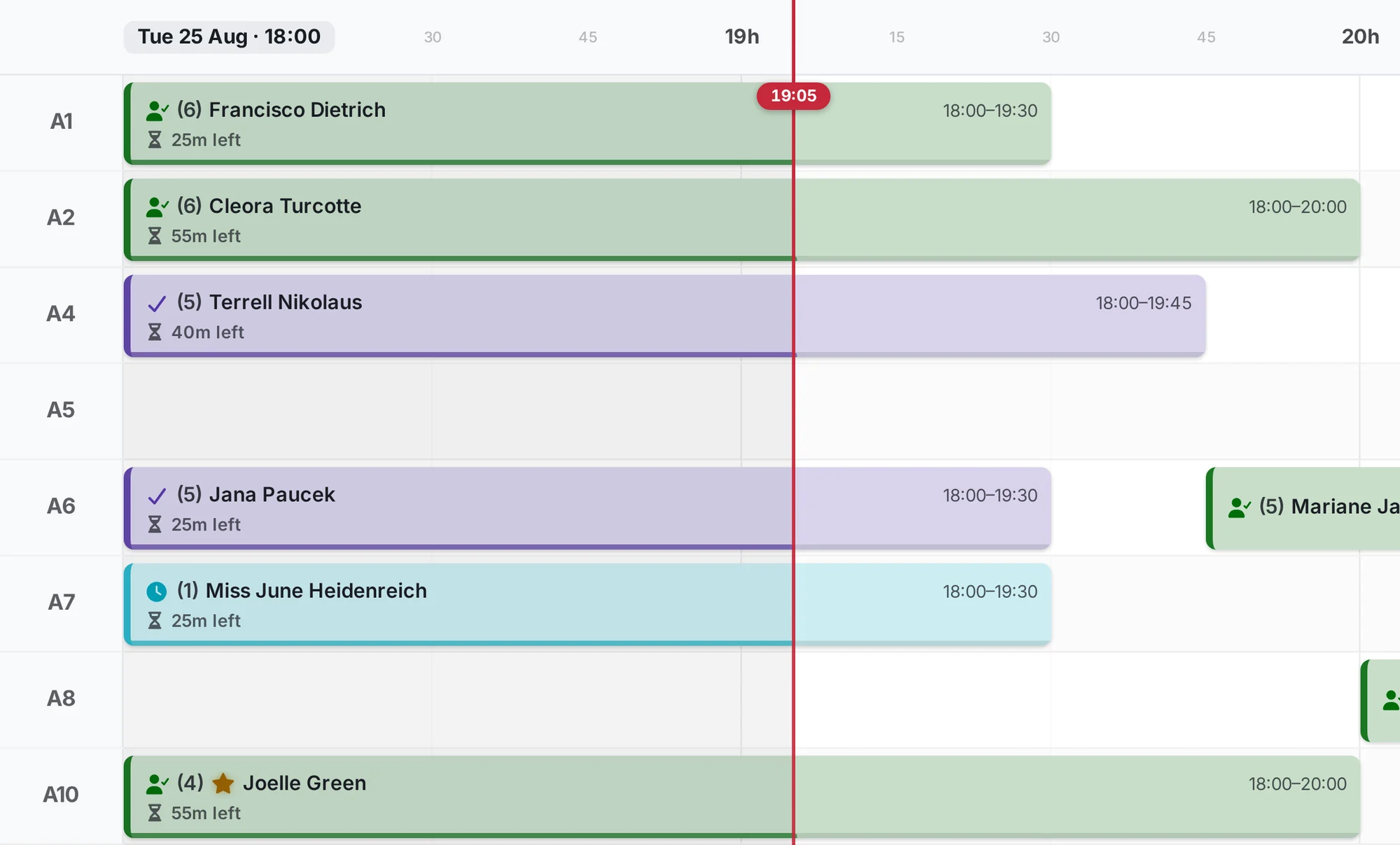
The minutes between two parties
The gap between one party and the next is yours to control. Fifteen minutes lost on each of 20 tables is five hours of empty tables in one evening.
- Know which tables turn next. A host who can see that three tables are within ten minutes of their time can have the next parties ready.
- Clear and reset in one pass, with what the table needs kept close by.
- Free the table in your booking system the moment the guests leave, so the host does not seat from memory.
- Keep a waitlist, and seat from it as soon as a table is free, including the tables that emptied early.
- Seat walk-ins at tables that would otherwise stand empty until their booking, if the time in between is long enough.
Raising it without rushing guests
Turnover has a ceiling, and it is the guest's patience. A restaurant that clears plates while people are still eating gets its second turn tonight and loses the table for good. Everything above works on the time around the meal: the empty hour before a mid-evening booking, the wait for the bill, the uncleared table. Leave the eating alone.
Check the effect in your own numbers. If turnover rises and guests still come back, the change was right. If the average bill per party falls, you gained a turn and lost a course.
Common mistakes
- Measuring by the day, so a strong dinner hides a weak lunch.
- One booking length for every party size.
- Offering every time slot, so each table is booked once in the middle of the evening.
- No waitlist, so early departures are wasted.
- Chasing turnover on a quiet night, when there is nobody to take the table anyway.
- Hurrying guests at the table instead of fixing the gaps around them.
Table turnover in Firetable
Firetable shows the service on a timeline: one row per table, one block per booking and a red line for the current time. Seated parties show how long their table has left, so the host knows which tables turn next. Walk-ins and waiting parties sit in a waitlist tray under the timeline. Drag one onto a table and a time to seat them, or drag the end of a block to give a party longer. Moves are staged first and reach the rest of the team when you save. When guests leave, you end the visit and the table is free for the next party. The booking widget offers times from your opening hours, and late slots are shortened to closing time and marked. Analytics show your busiest hours and how many guests turn up or cancel. See reservation timeline software and table management software.